2026 · 5 min read
We The People: Your Rights
A plain-English Constitution and Bill of Rights reference, built in a matter of weeks and shipped free forever
- Client
- WildTech Ventures, LLC
- Role
- Concept, design, iOS development, content, App Store launch
- Stack
- SwiftSwiftUIOffline-first storageApp Store
Cost to user
Free, forever
Tracking
Zero
Works offline
Yes
We The People: Your Rights is the most personal app we have ever shipped. The full origin story lives on the founder page, but the short version is that it started with a conversation in a men's society meeting where someone passed around a small pocket Constitution and said this was the most important thing anyone in the room owned. We agreed. We also realized that almost nobody actually carries one of those, and that the modern equivalent should be on the phone in your pocket.
The app shipped to the App Store on a fast schedule, free, with no ads, no tracking, no in-app purchases, and no account required. It is the kind of project that did not need to make money to be worth building.
The problem#
Civic literacy in America is in a bad place. Multiple national surveys have shown that a majority of adult Americans cannot name the three branches of government, do not know what the Bill of Rights protects, and have no idea what their actual rights are during a traffic stop, a search, or any other interaction with the state. This is not a partisan problem. People across the political spectrum agree that the situation is embarrassing.
The standard responses to this problem are slow and indirect. Better civics education in schools. More substantive coverage in mainstream news. Long-form books and essays for people who already care. All of those are good and worth pursuing, but none of them put the actual text of the Constitution into someone's hand at the moment they need it.
The opportunity was to build the simplest possible reference tool. Original text. Plain-English explanations next to it. Real-life scenarios that map abstract rights to concrete situations like traffic stops or searches. Free to anyone who wants it. Works offline so it is reliable even when the network is not.
The approach#
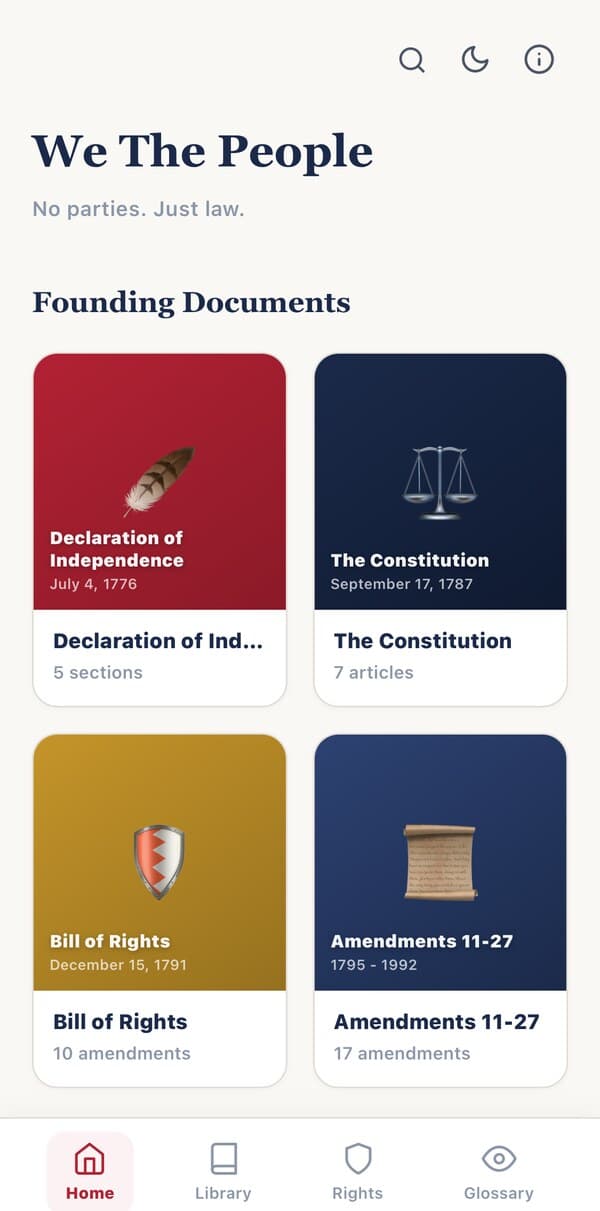
The app is intentionally minimal. There is no signup flow. There are no notifications. There is no social layer. The only thing the app does is let you read and search the Constitution, the Bill of Rights, and the founding documents, with accessible explanations alongside the original text.
The plain-English explanations are the hardest part of the content work. They have to be accurate enough that a constitutional lawyer would not roll their eyes, accessible enough that a teenager can read them, and balanced enough that a reader of any political affiliation can recognize them as fair. We wrote them with that triple constraint in mind and tested every section by reading it aloud to people across a range of education levels and political beliefs.
The real-life scenarios section is the part that turns the app from a reference into a tool. It is one thing to know that the Fourth Amendment exists. It is another thing entirely to know what you should say if a police officer asks to search your car. The scenarios cover the situations where rights actually come up in normal American life.
The whole thing is offline-first. The app downloads its content on first install and works without a network connection forever after. We made this choice because the moments when you most need to know your rights are not the moments when you can count on having signal.
The technical work#
The app is native iOS, written in Swift with SwiftUI. The content is shipped inside the app bundle rather than fetched from a server, which means the app does not phone home and there is no possibility of the content being changed after you install it. The whole app is a few megabytes.
The search is a custom full-text index over the document content, designed to handle the kind of fuzzy queries people actually type. Searching for "free speech" returns the relevant amendments and their explanations. Searching for "can the police search my car" returns the relevant scenario along with the constitutional sections that apply.
There is no analytics. There is no user account. There is no telemetry. The privacy policy is short because there is nothing to disclose.
The launch#
The app launched in May 2026 on a tight schedule. The first version was in the App Store within weeks of the idea taking hold. We chose to ship a deliberately small first version rather than wait until the app was comprehensive, because the most important thing was to put the tool into people's hands as fast as possible. Future versions will expand the content and add features like additional founding documents, state constitutions, and more scenarios.
The App Store review process for this app was uneventful. We had been worried that the political sensitivity of the content might trigger extra scrutiny. It did not. The app was approved on the first submission.
Why this matters#
We The People: Your Rights is not a commercial project. It is free, it will stay free, and it makes no money. We built it because we thought it should exist and we had the skills to build it.
For clients, the lesson is that we take ideas seriously enough to ship them, even when there is no obvious business model. If you bring us a project that has to be built for reasons other than revenue, we know how to do that work. The discipline of shipping a free product where the only reward is the work itself is the same discipline that makes the paid client projects we take on come out well.
If you have an idea that needs to exist in the world, let's talk about how to make it real.