2026 to present · 5 min read
Viking Sensors
Precision climate monitoring hardware, distributed nationally through one of the country's leading metrology firms
- Client
- Viking Sensors, LLC (operating brand of WildTech Ventures)
- Role
- Product design, hardware design, firmware, web dashboard, distributor relationship
- Stack
- Custom hardwareEmbedded firmwareCloud telemetryReal-time dashboardsIndustrial enclosure
Distribution
MSI-Viking Gage
Industries
Calibration, server, cleanroom
Reliability
Industrial grade
Viking Sensors is the longest-running and most operationally mature product in the WildTech portfolio. It is a line of precision climate monitoring devices paired with cloud telemetry and dashboards, sold into calibration labs, server rooms, warehouses, cleanrooms, and any other environment where temperature and humidity have to stay inside narrow bounds and someone has to be able to prove it.
The product exists because the off-the-shelf options were not good enough. Consumer sensors are not accurate enough for calibration work. Industrial sensors are accurate but ship with software that looks like it was last updated in 2005. The gap between "accurate" and "usable" was a real product opportunity, and Viking Sensors fills it.
The problem#
Metrology labs and similar precision environments have a regulatory and operational need to continuously monitor temperature and humidity. Out of compliance conditions invalidate calibrations and force expensive recalls. The legacy tools for this job split into two unsatisfying buckets.
The first bucket is data loggers. These are small battery-powered devices that record temperature and humidity to internal memory, which someone then has to manually offload to a computer once a week or once a month. Data loggers are accurate but require constant babysitting. If a fridge fails on Friday night, the data logger will faithfully record the failure, but nobody will know about it until Monday morning, by which point the calibrations that were being protected are already out of compliance.
The second bucket is enterprise environmental monitoring systems. These do real-time alerting but are expensive, slow to install, and almost universally come with software that looks like a Windows Vista screenshot. The big names in this space have not meaningfully updated their user interfaces in twenty years. The hardware is reliable. The user experience is hostile.
The opportunity was to combine the accuracy of the enterprise systems, the simplicity of the data loggers, and the user experience of a modern consumer product, then sell it at a price point that made sense for the calibration lab market.
The approach#
The Viking Sensors hardware is purpose-designed for precision and reliability. Each sensor uses high-accuracy temperature and humidity components, an integrated wireless radio for real-time telemetry, and a custom enclosure that holds up in industrial environments. The firmware is written to minimize the kind of corner-case failures that come from cheap consumer wireless chips. The cloud side is a custom backend that ingests, stores, and serves the sensor readings to a web dashboard built for the people who actually have to look at it every day.
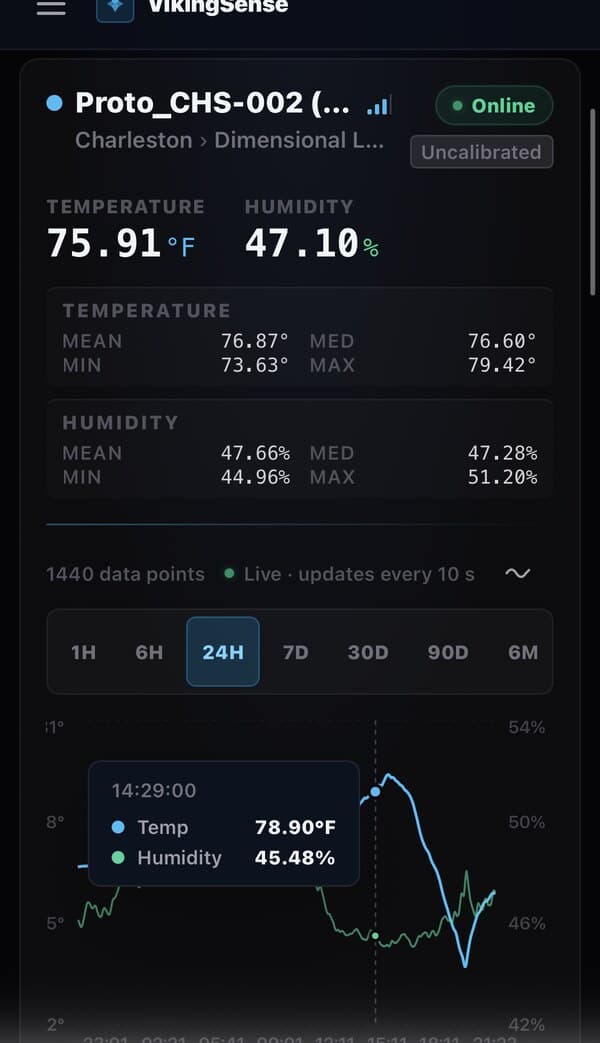
The dashboard does the things you would expect from a modern web product. Live readings on a single screen. Historical graphs with adjustable time windows. Configurable alert thresholds. Email and SMS notifications when readings drift out of bounds. CSV export for compliance reporting. Multi-user accounts so a lab manager can see all the sensors across multiple rooms or facilities.
The design language is intentionally restrained. There are no decorative gradients, no marketing colors, no dashboards that look more like a startup pitch deck than a tool. The people using Viking Sensors look at this dashboard every day. The job of the design is to disappear and let them see the data.
The distribution decision#
The single biggest decision we made on Viking Sensors was choosing how to sell it. Two paths were open. The first was direct sales: build a website, run ads, do outbound. The second was distribution: partner with someone who already had the customer relationships in the metrology space.
We chose distribution. Viking Sensors is sold exclusively through MSI-Viking Gage, one of the largest names in precision measurement in the United States. MSI-Viking has decades of relationships with the calibration labs that need this kind of monitoring, a sales team that understands the technical requirements, and the credibility that comes from being a known quantity in the industry.
The trade off is that the exclusive distribution arrangement means we are not selling Viking Sensors directly. We share margin with the distributor, and we accept that the customer relationships sit with MSI-Viking rather than with us. In exchange, we get access to a customer base that would have taken us years to build from scratch and a sales motion that fits the buying behavior of the market.
For a small product company, that trade is usually correct. Building a sales organization from zero is hard, slow, expensive, and not the highest-leverage thing a small team can do. Picking the right distribution partner and letting them sell is often the right answer.
What we shipped#
Production hardware in industrial enclosures, with the kind of certifications and testing required to be deployed in regulated environments.
A real-time telemetry backend that ingests sensor readings, stores them long-term, and serves them to the dashboard with minimal latency.
A web dashboard for live readings, historical analysis, threshold configuration, and alerting.
An ongoing operational arrangement with MSI-Viking Gage as the exclusive distributor.
Continued firmware and software updates as customer feedback comes in from the field.
Why this matters for clients#
Viking Sensors is the case study that proves WildTech can ship full-stack hardware and software products end to end. If you are evaluating a partner for a project that has a custom hardware component, the question you should be asking is whether they have done this before. We have, at industrial scale, with a national distribution partner. That experience is rare in the kinds of small studios and freelancers who claim to do hardware work.
If you have a hardware idea that needs to become a real product with real customers, we have walked the entire path from sketch to shipping units. Let's talk.