2024 · 4 min read
Spirits of Charleston
The Lowcountry's most comprehensive ghost story app, narrated and GPS-tagged across an entire region
- Client
- WildTech Ventures, LLC
- Role
- Concept, content, design, iOS development, audio production, App Store launch
- Stack
- SwiftSwiftUIMapKitAVFoundationOffline contentApp Store IAP
Stories
75+ narrated
Coverage
Tri-County and beyond
Rating
5.0 on App Store
Spirits of Charleston is what happens when a software developer who grew up on the Lowcountry's haunted history sits down to ask why no good tool existed for exploring it.
Charleston has a deep, real ghost story tradition that goes back centuries. There are walking tour companies that have built whole businesses around it. There are books, websites, and the occasional television special. What there was not, before this app, was a single comprehensive reference that covered the whole region, included professional audio narration, mapped every story to a real place you could visit, and let you explore at your own pace without paying a tour guide forty dollars to spend ninety minutes downtown.
That gap was the opportunity, and Spirits of Charleston filled it.
The problem#
Existing ghost tours have three structural problems. They only cover the most touristy downtown stops, because that is where the foot traffic is. They run on a fixed schedule, which is great if you happen to be free at 8 PM on a Saturday and terrible if you are visiting with kids who are tired by then. And they are expensive on a per-person basis, especially for families.
A self-guided app could solve all three of those problems. It could cover the whole region, not just King Street. It could be available whenever the user wants to use it. And one purchase could cover an entire family for as many evenings as they wanted to explore.
The harder problem was content. To make the app actually worth buying, it had to have more stories than any walking tour, with audio that did not sound like a hobby project, and with historical accuracy that local readers would not laugh at.
The approach#
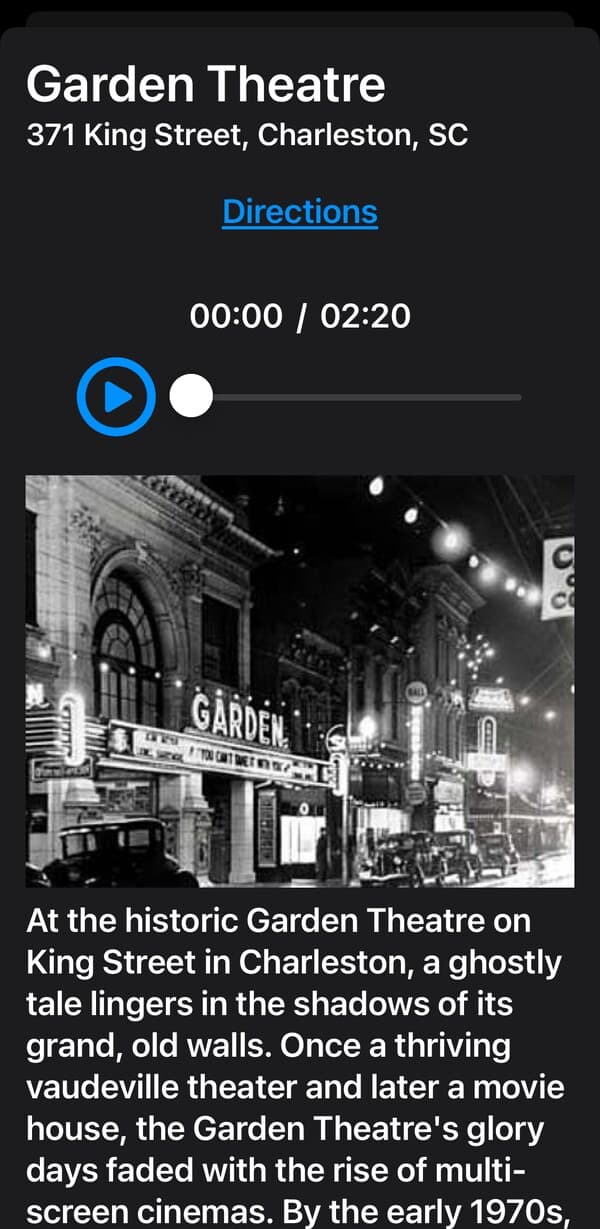
We wrote and recorded over 75 narrated stories. Each story is tied to a real location with GPS coordinates, comes with historical photographs sourced from libraries across South Carolina, and runs anywhere from three to ten minutes depending on the depth of the material. The narration is professional, recorded with proper microphones in a quiet space, edited for pace, and matched to background ambience appropriate to the location.
The app's coverage extends far beyond what any walking tour offers. Downtown Charleston is well represented, of course. The Old City Jail, the Unitarian Church graveyard, the Powder Magazine, Cabbage Row. But the app also covers Summerville, Moncks Corner, the beaches, the islands, the colonial cemeteries, the forts, and the back roads. Stories that have been told for generations in specific corners of the Lowcountry, never written down anywhere accessible, and certainly never narrated.
The technical implementation is straightforward. Native iOS, SwiftUI for the interface, MapKit for the GPS-tagged locations, AVFoundation for audio playback. All content is bundled with the app and works offline, which matters because cell service on the islands and back roads is unreliable.
The business model#
Spirits of Charleston is a one-time purchase of $4.99. No subscription. No ads. No in-app purchases. You buy it once and own it.
This decision was deliberate. Subscriptions are the default business model for content apps in 2024, but they make no sense for an app that is essentially a guidebook. Nobody subscribes to a guidebook. You buy it, you use it, and you keep it. We priced the app to be obviously cheaper than a single ghost tour ticket, so the value comparison was easy.
The model has worked. The app maintains a 5.0 rating on the App Store, and the reviews repeatedly mention how much value the user got compared to taking a traditional tour.
What App Store users have done with it#
The reviews are some of the most rewarding we have read on any of our apps. People describe planning whole evenings around the app, hitting haunted locations between dinners and bar stops. One reviewer mentioned that the app turned a vacation that was supposed to be just a beach trip into a flexible ghost tour spread across the entire week. Another said the app worked even better than expected with kids because the family could pause, skip, and resume on their own schedule.
The recurring theme across the reviews is the flexibility. People are not used to a ghost tour that fits around their schedule rather than the other way around.
Why this matters#
Spirits of Charleston is a working example of what we mean by content-driven apps. The development cost was not in the code. The code is straightforward. The cost was in the writing, the historical research, the photo licensing, and the audio production. An app like this only works if you take all of those parts seriously.
For clients with content-heavy app ideas, the lesson is to budget for the content, not just the code. The app is the wrapper. The content is the product.
If you have a guidebook, an audio tour, a reference work, or any other content-driven idea that wants to be a beautiful, simple, offline-capable app, we have shipped the model. Let's talk.