2025 · 3 min read
Spirits of Savannah
A second city, a second app, and a deeper map than any walking tour offers
- Client
- WildTech Ventures, LLC
- Role
- Concept, content, design, iOS development, audio production, App Store launch
- Stack
- SwiftSwiftUIMapKitAVFoundationOffline content
Stories
55+ and growing
Coverage
Squares to Ossabaw Island
Price
$3.99 one-time
Spirits of Savannah is the second app in the Spirits series and the first product where we proved the model could repeat. The Charleston version had been live for most of a year, had earned a 5.0 rating, and had attracted enough positive feedback that the obvious question was whether the same approach would work in another haunted Southern city. Savannah was the answer.
The app launched in January 2025 with over 55 narrated stories, the same offline-first technical architecture, and the same business model. One-time purchase, no ads, no subscription.
The problem#
Savannah has a ghost story industry that is, if anything, larger than Charleston's. There are dozens of walking tour companies. The downtown squares are saturated with guides shepherding small groups from one spooky stop to the next. The market for ghost content in Savannah is so dense that the question was not whether there was demand. It was whether a self-guided app could offer something the walking tours could not.
The answer turned out to be coverage. The walking tours all cover the downtown squares because that is where the foot traffic is. They do not cover Ossabaw Island, Hardeeville across the South Carolina line, the colonial cemeteries on the outskirts, or the haunted plantation roads that families with cars can easily visit.
The app could cover all of that, plus the downtown squares, in a single coherent product.
The approach#
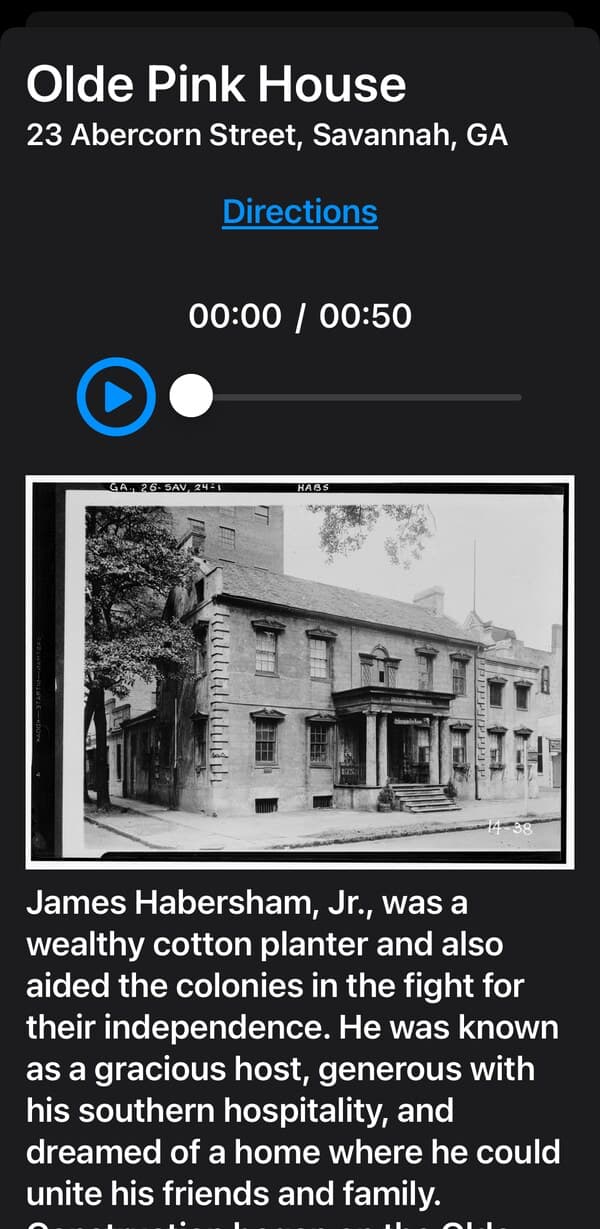
The technical implementation is essentially the same as the Charleston version. Native iOS, SwiftUI, MapKit for GPS-tagged locations, AVFoundation for audio playback, all content bundled with the app for offline use. The shared architecture meant that the second city took dramatically less engineering time than the first.
The content was where the work went. Writing 55 stories that were accurate, well-paced, and worth a listen took months. Recording professional narration for each story took another long stretch of careful audio production. Sourcing historic photos and verifying that the locations were real and visitable was its own line of work.
The breadth of coverage is what makes the Savannah app worth buying alongside or instead of a downtown walking tour. A first-time visitor doing the standard squares-and-restaurants trip can use the app for the downtown portion of their visit and pick up everything the tours cover, then keep using it for the trips out to Ossabaw or the colonial cemeteries that walking tours never reach.
What changed from the first app#
A few small things improved between Spirits of Charleston and Spirits of Savannah. The audio production got tighter. The historical research process was faster because we had the workflow down. The map view loads more quickly because we cached more aggressively.
The business model stayed the same. One-time $3.99 purchase. The price is slightly lower than Charleston, partly because the story count is slightly lower at launch, and partly because we wanted to make the second-city upgrade easy for people who already owned the first one.
What we learned#
The repeatable framework is what made Spirits of Savannah possible at the price and quality it shipped at. The first city in any content-driven app series carries all of the architectural risk. Once that is done, the second one is a content project on top of a known technical foundation.
This is a useful pattern for any client thinking about a content-driven product. If you have content for one location, region, market, or audience, and you suspect the same product would work in others, build the first one with the assumption that you will repeat it. The architecture that supports content swapping cheaply is worth a small amount of extra work up front and pays for itself the second time you ship.
If you have a content product that you think could work across multiple cities, regions, or audiences, let's talk about how to build the foundation right.